
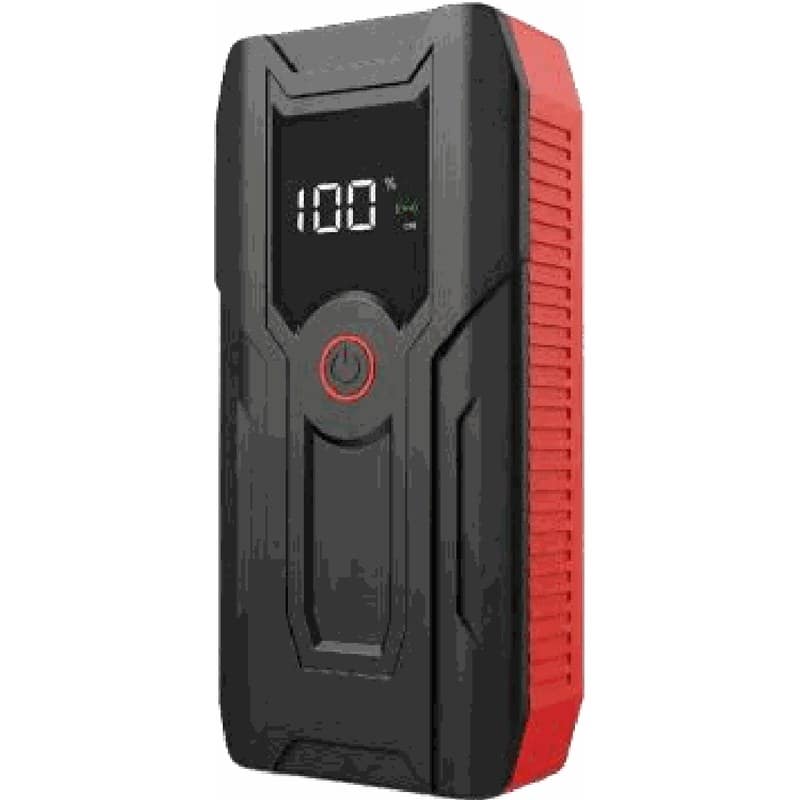

A jump starter box usually says "1000A peak". The number is not false, but it does not mean what most buyers assume.
Three numbers, three different things
Peak amps is the maximum current the pack can deliver for a few hundred milliseconds. Cranking amps is what it can sustain for around 30 seconds without dropping below 7.2V. Battery capacity (mAh) decides how many starts you get.
A product rated 1,000A peak typically delivers 400-500A of cranking current. That is not a fake spec: it follows from cell chemistry. Peak and sustained are simply different measurements.
How many starts does 6000mAh give you
One start of a 2.0L petrol engine consumes roughly 3-5% of charge. So a 6000mAh pack could theoretically do 15-20 starts, but in practice you should stay under five, because deep discharge accelerates cell ageing.
For a 3.0L-plus diesel, each start roughly doubles the draw, so plan on half the runtime.
Why cold weather is the real test
Lithium internal resistance rises sharply at -20C, and discharge capability can drop by more than half. If your market is northern North America or the Nordics, ask the factory for cold-start test data. Plenty of "1000A" units cannot start a diesel below -10C.
Safety design matters more than the spec sheet
What actually decides whether a product can be sold are the protections: reverse polarity, short circuit, over-temperature and over-charge. Reverse polarity is the most important, because connecting the clamps backwards is the single most common user error. Without that protection you burn the board, or worse.
Ask whether reverse polarity is handled in hardware or software. A hardware solution (MOSFET plus sensing circuit) costs more but responds instantly; a software solution is cheaper but has latency.
Certification
Any product with a lithium pack needs a UN38.3 report for air and sea freight. The EU also requires CE (EMC and LVD); the US requires FCC. UL is not mandatory, but large retail channels usually ask for it.
Ningmei supplies six jump starter models (DY01 to DY10) plus twelve 2-in-1 and 3-in-1 combo units, with cell configuration and certification tailored to the destination market.